
House and Land Packages Explained: What's Included and How to Compare
19 Mar 2026

If you're exploring your options for a new home in Perth or Melbourne, chances are you've come across the term "house and land packages." It's one of the most popular ways Australians build new homes — and for good reason. But what exactly is a house and land package, how does the pricing work, and what should you look out for when comparing options between builders?
In this guide, we've got house and land packages in Perth explained in plain language, so you can make an informed decision with confidence.
What Is a House and Land Package?
A house and land package bundles two separate purchases into one streamlined process: a block of land in a new estate and a home design built on that land. While it feels like a single purchase, it actually involves two separate contracts — one for the land with the developer and one for the build with the builder. This is known as a dual-contract structure.
Here's how it typically works:
- You choose a home design from a builder's range — whether that's a three-bedroom single storey home or a spacious four-bedroom two-storey design.
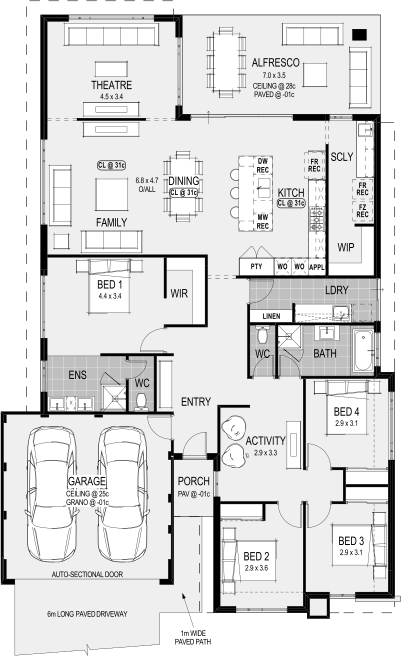
- The builder matches your chosen design to a specific block of land in a partnered estate, ensuring the home fits the block's dimensions, orientation, and any local covenants.
- You sign two contracts — one for the land purchase and one for the building contract.
- The land settles first, and then construction begins on your new home.
The beauty of this approach is that someone has already done the hard work of making sure the home design suits the block. The builder's team has checked the lot size, orientation, setbacks, and any estate guidelines — so you don't have to figure all of that out yourself.
For first home buyers especially, this takes a lot of the guesswork (and stress) out of the process.
What's Typically Included (and What's Not)
One of the biggest questions buyers have is: what am I actually getting for my money? The answer varies between builders, which is exactly why it's so important to understand what's included before you sign.
What's usually included
Most house and land packages will include:
- The land — a registered (or soon-to-be-registered) block in a new estate
- The home build — construction of the home design from slab to completion
- Standard inclusions — basic fixtures, cabinetry, paint, and essential fittings
- Site preparation — basic site costs for a standard block (though this varies — more on that below)
- Council and compliance fees — building permits and inspections required by local council
Where builders differ
This is where things get interesting. Some builders strip back their base packages to advertise a lower headline price, then charge extra for things you'd expect to be standard. Others bundle premium inclusions from the start.
For example, our packages include up to $80,000 worth of European-styled inclusions across our Designer and Luxury kitchen specifications — featuring premium European style cabinetry, quality appliances and fittings that other builders might list as costly upgrades.
Common upgrades to watch for:
- Ducted or split-system air conditioning
- Upgraded flooring (e.g. timber-look tiles or hybrid flooring)
- Window treatments (blinds, curtains)
- Landscaping and fencing
- Driveway and crossover
- Alfresco or outdoor living areas
- Smart home wiring and security
The key takeaway: Always ask for a full list of inclusions and compare like for like. A package that looks cheaper upfront may end up costing more once you add the extras you actually need to move in.
How to Compare House and Land Packages Between Builders
With so many builders advertising house and land packages, it can feel overwhelming trying to work out which one offers genuine value. Here's a practical framework to help you compare apples with apples.
1. Compare the total cost, not just the headline price
The advertised price is a starting point, not the finish line. Ask each builder for a detailed cost breakdown that includes:
- Land price
- Base build cost
- Standard inclusions (get the full list)
- Estimated site costs
- Any promotional inclusions or bonuses
2. Check what's included as standard
As mentioned above, inclusions vary dramatically between builders. One builder's "luxury" package might be another's base offering. Pay close attention to kitchen specifications, bathroom fittings, flooring type, and climate control.
3. Ask about the builder's track record
Experience matters when it comes to building a home. Look for builders with a proven track record, industry recognition, and transparent processes. At Home Group, we're an award-winning builder with over 30 years' experience and recognition from both the Housing Industry Association (HIA) and the Master Builders Association (MBA).
4. Understand what happens after you sign
The build process can take several months, so it's worth asking about:
- Communication — How will you be kept informed during construction?
- Quality assurance — Are there independent inspections during the build?
- Guarantees — What structural and maintenance warranties are included?
We provide a free independent building inspector who attends the site and completes a quality control inspection — giving you peace of mind that your new home meets Australian Standards. We also offer a lifetime structural guarantee with four months of free maintenance after handover.
Understanding Siteworks and Hidden Costs
Siteworks are one of the most misunderstood aspects of building a new home — and they're often the reason a final bill comes in higher than expected.
What are siteworks? They're the preparation works needed to get your specific block ready for construction. This can include:
- Earthworks — levelling or cutting and filling the land to create a flat building platform
- Rock removal — if the block has rock below the surface, it needs to be excavated
- Soil testing and piering — reactive or unstable soils may require additional foundation work
- Retaining walls — required if your block has a significant slope
- Service connections — connecting water, sewer, gas, electricity, and telecommunications
The cost of siteworks depends on the condition of your specific block — its slope, soil type, rock presence, and how services are positioned. Two blocks sitting side by side in the same estate can have very different site costs.
How to protect yourself:
- Ask the builder for an estimated site cost based on the specific lot you're considering
- Find out if the builder has already completed a soil test on the block
- Check whether any site costs are included or capped in the package price
- Ask what happens if site conditions turn out to be worse than expected
House and Land vs Buying Established — Pros and Cons
If you're weighing up whether to go with a house and land package or purchase an established home, here's how the two options stack up.
Advantages of house and land packages
- Stamp duty savings — When you purchase a house and land package, you typically only pay stamp duty on the land component, since the house doesn't exist yet. This can save you thousands of dollars compared to buying an established home where stamp duty is calculated on the full purchase price.
- Government grants — First home buyers building a new home may be eligible for the First Home Owner Grant (FHOG) and other state-based incentives. In WA, this can be paired with low-deposit loans through Keystart to make home ownership even more achievable.
- Brand new everything — New appliances, new fixtures, modern energy efficiency, and current building standards. No surprise maintenance costs from day one.
- Customisation — Choose your home design, colour scheme, and finishes to create a home that genuinely suits your lifestyle.
- Builder warranties — New builds come with structural guarantees and defect liability periods, giving you protection that an established home simply can't match.
Considerations to keep in mind
- Build time — You'll need to wait for construction to complete, typically 6–12 months depending on the builder and market conditions.
- Location — House and land packages are typically in new estates and growth corridors, which may mean developing infrastructure or longer commutes initially.
- Landscaping and extras — Most packages don't include landscaping, fencing, or window treatments, so budget for these separately.
For many first home buyers, the stamp duty savings and grant eligibility alone make house and land packages the more financially attractive option.
What to Expect in Perth and Melbourne
Perth
Perth's house and land market offers strong value across the northern and southern suburbs. House and land packages in Perth are available across a range of price brackets — from entry-level options suited to first home buyers and investors through to premium packages in sought-after estates. Buyers in WA also benefit from the First Home Builders Hub, the First Home Owner Grant, and low-deposit home loan options through Keystart (a WA-specific provider), making it more accessible than ever to get into a new home.

Melbourne
Melbourne's market spans the north, west, south-east, and Geelong regions, with house and land packages ranging from the mid $400,000s for compact designs through to over $1.1 million for premium packages, depending on location, lot size, and home design. Growth corridors like Tarneit, Clyde North, and Armstrong Creek continue to offer strong options for buyers across a range of budgets.

In both markets, working with an established builder who has strong developer partnerships means you're more likely to get access to exclusive land releases and competitive package pricing.
How to Get Started with a House and Land Package
Ready to take the next step? Here's a simple roadmap to get you moving:
- Get your finances sorted — Speak to a finance specialist about your borrowing capacity, deposit requirements, and any grants you may be eligible for. Our in-house finance team can guide you through this entire process.
- Choose your preferred location — Think about where you want to live, your daily commute, nearby schools and amenities, and the area's future growth potential.
- Browse home designs — Explore the range of home designs available to find one that suits your lifestyle, family size, and block preferences.
- Review packages carefully — Compare inclusions, estimated site costs, and total pricing across builders. Don't be afraid to ask questions — a good builder will be transparent about every dollar.
- Visit display homes — Seeing a home in person is the best way to understand the quality of inclusions, the flow of a floor plan, and the level of finish you can expect.
- Make an enquiry — Once you've narrowed down your options, reach out to the builder's sales team to discuss available lots and get a detailed, obligation-free quote.
Whether you're a first home buyer taking your first step onto the property ladder, an investor looking for a smart opportunity, or a growing family ready to build your next home, a house and land package is one of the most straightforward paths to a brand new home.
The key is understanding what's included, comparing your options carefully, and choosing a builder you can trust to deliver on their promises. With the right guidance and a transparent builder by your side, you'll see the difference a well-matched house and land package can make.
Stay up to date!
Subscribe to receive the latest articles, exciting updates, and exclusive offers straight to your inbox!
Thank you!
We'll keep you updated.
Recent Articles

Home Design Trends for 2026: What Australian Buyers Actually Want
If you're planning to build a new home in 2026, you've got better options than buyers have had in years. The trends shaping new builds...
Read Article
Understanding 7-Star Energy Ratings: What It Means for Your New Home
Building a new home in Australia comes with exciting decisions about design and location. But there's one requirement that affects every...
Read Article
Building Your First Home in Perth: Best Growth Suburbs in 2026
Perth's property market has led the nation over the past five years — dwelling values up nearly 90% according to Cotality (formerly...
Read Article